


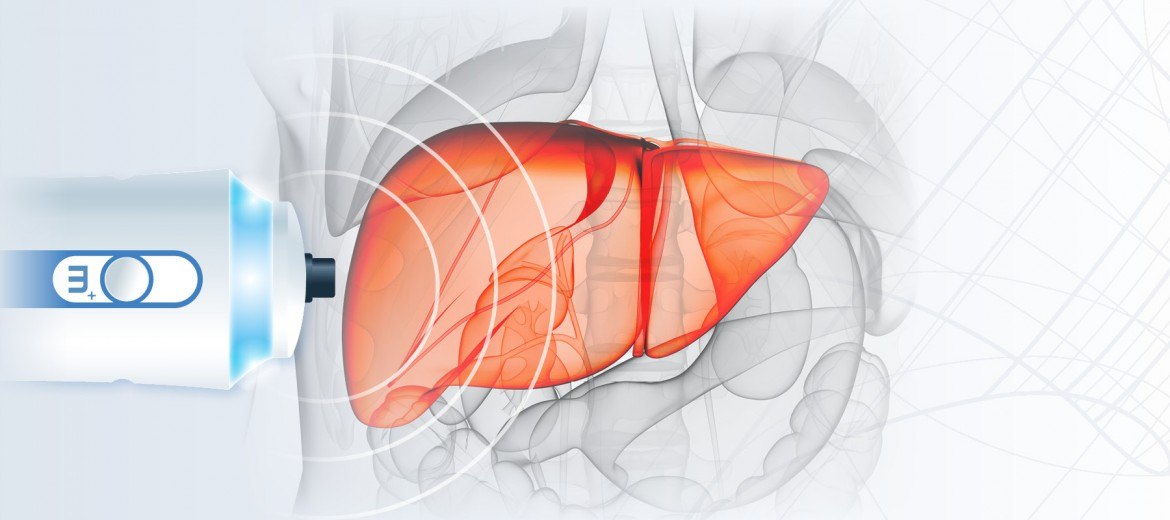
What is FibroScan?
FibroScan is a new high-tech medical device, which measures the stiffness (elasticity) of the liver without any intervention in the body, painlessly and easily, using ultrasound waves. With its special scanning tips, it measures the degree of liver stiffness and predicts with high accuracy the damage (especially advanced fibrosis) in the liver. The FibroScan device examines an area at least 100 times larger than the area of tissue that can be taken from the liver with a biopsy.
What does liver stiffness (LIVER STIFFNESS) mean?
Chronic liver diseases (Hepatitis B, Hepatitis C, fatty liver disease, hepatitis caused by taking medications and other liver diseases) can cause damage to the liver over time, as the damage may cause scarring (fibrosis) over time. As fibrosis progresses, the liver hardens even more. The final stage of fibrosis is cirrhosis. FibroScan measures liver stiffness and predicts the fibrotic stage of the liver.
Does FibroScan measure fatty liver?
The devices, which have a CAP function, calculate much more accurately than ultrasound devices and numerically the degree of fatty liver. CAP is an optional feature and may not be found in every device. We use the latest models of machines that have the CAP function.
What are the benefits of FibroScan?
The method that best assesses the condition of the liver is liver biopsy. However, due to the fact that it is painful, requires intervention, and sometimes causes serious complications (such as haemorrhage), it creates anxiety in patients. FibroScan can prevent unnecessary biopsies for many diseases and in many diseases can be used to monitor the effectiveness of treatment. Monitoring of liver disease can be accomplished by administering FibroScan at intervals specified by a physician, without pain and inconvenience (monitoring by repeated biopsies is not reasonable or appropriate). However, having a FibroScan administered does not always eliminate the need to perform a biopsy.
One of the diseases FibroScan is best to use is non-alcoholic fatty liver disease (NAFLD). NAFLD is a liver disease that is quite common (on average 25% of the community). We usually spot it incidentally, during an ultrasound examination. And in steatohepatitis (NASH), which is the expansive form of NAFLD, usually the liver enzymes (AST, ALT) are slightly elevated. NASH can be accompanied by fibrosis and in 10-20% of these patients over a period of 10 years, progression of fibrosis can develop cirrhosis. Conventional imaging modalities (ultrasound, CT, MRI) cannot detect fibrosis in patients suffering from fatty liver. And early detection of fibrosis and identification of individuals who are at risk for cirrhosis is of significant importance in order to take necessary measures such as diet and exercise.
A definitive diagnosis of fibrosis is only made with liver biopsy and that is why it is of great importance that when fatty liver is quite common, patients be scanned with FibroScan to detect advanced fibrosis, which may be a precursor to cirrhosis. This method is also useful to see to what extent the fatty liver has healed with diet, exercise and other therapies. Moreover, the fact that it provides a numerical value for fatty liver is an important advantage in follow-up, whereas with ultrasound and other methods, the follow-up of the fat cannot be done with numerical values.
Why is FibsoScan needed?
Nowadays, every 4-5 people suffer from fatty liver. In other words, the incidence of fatty liver in our country is 20%. It is definite that even if there is no alcohol use, it can develop into cirrhosis. FibroScan, which is a simple method, can prevent many unnecessary liver biopsies and has been used worldwide in recent years.
Can FibroScan be used in every patient?
It is not recommended to apply FibroScan in the presence of fluid in the abdomen (ascites) and to individuals wearing a medical device (such as a pacemaker or an electroshock machine). FibroScan measurement in some individuals (e.g., with rib stenosis or overweight) may be all but unsuccessful (5%). With a scanning tip (XL prob) produced by the manufacturing company, the success rate for scanning overweight individuals is increased.
How is the FibsoScan procedure performed?
The person to be scanned lies on their back so that their right arm is under their head. The scanning tip of the device is smeared with gel and by making contact with the skin between the ribs of the lower right side of the chest a different number of measurements are taken. At this time, no pain is experienced, only the presence of the sound waves can be felt. The duration of the procedure is about 5 min. The results are given immediately after the procedure. No preparation is necessary before the procedure. However, it is recommended that you do not consume food 2 hours before the procedure.
How is the FibroScan result report evaluated?
In the report, the liver stiffness measurement will be defined as a value ranging between 1.5-75 kPa and the CAP measurement (indicating fat) as a value ranging between 100-400 dB/m. The results obtained must be commented on by a physician experienced in liver disease, taking into account the medical history, the laboratory findings, the quality of the measurement procedure (number of valid measurements, success rate, IQR/M rate) and the potential presence of other factors known to affect liver stiffness.